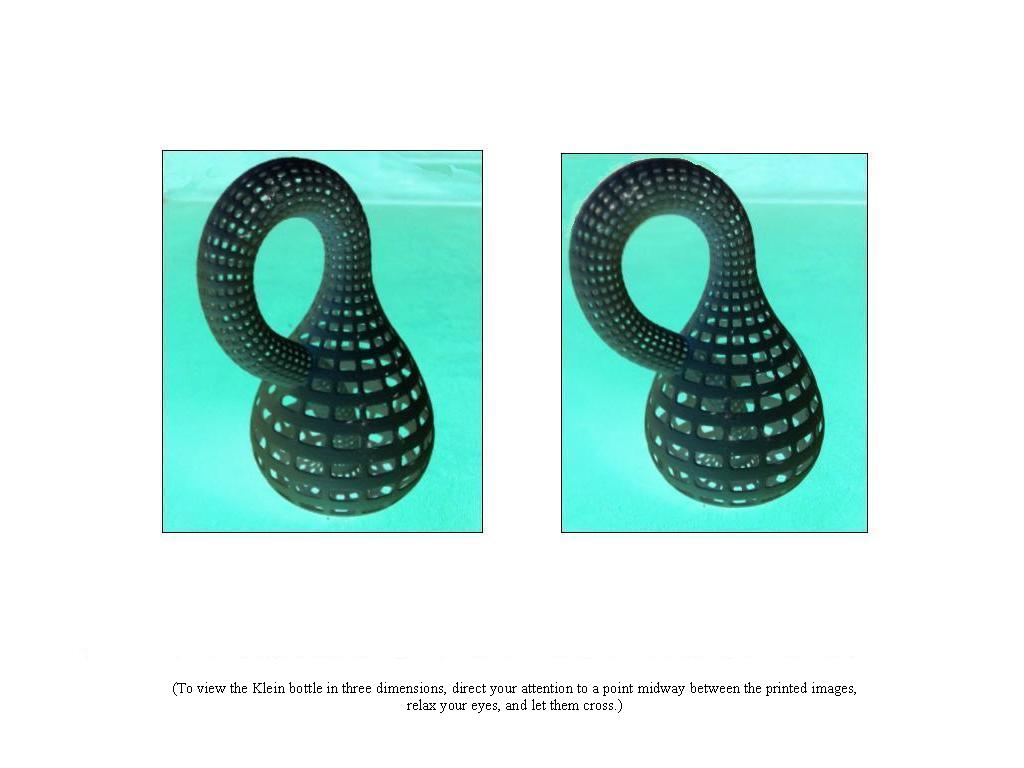
From Chapter 5 …
Though Jung did not allude to the Klein bottle, it is interesting that he gave archetypal significance to 3 + 1-dimensional structure, regarding it as a “space-time quaternio” constituting “the organizing schema par excellence among the psychic quaternities.” The 3-D spatial aspect of the Klein bottle can readily be associated with the spatial aspect of Jung’s quaternio; this feature clearly aligns with objectivity as well, given the role of space as the fundamental framework for objectification. Does the subjective aspect of the bottle align with time? Evidently, it does. Phenomenological philosophers such as Husserl, Heidegger, and Merleau-Ponty have probed deeply into the intimate relationship between temporal experience and core subjectivity. Merleau-Ponty, for example, begins a chapter on temporality by declaring: “In so far as…we have already met time on our way to subjectivity, this is primarily because all our experiences…arrange themselves in terms of before and after, because temporality…is the form taken by our inner sense, and because it is the most general characteristic of ‘psychic facts.’” The subject is essentially temporal “not by reason of some vagary of the human make-up, but by virtue of an inner necessity.” On this basis, we may indeed conclude that the unitary subjective component of the 3 + 1-dimensional Klein bottle is temporal in nature, thereby linking it to the temporal aspect of Jung’s 3 + 1-dimensional space-time archetype.